
What is Powder Metallurgy? A Complete Process Guide
From Metal Powder to Precision Parts: The Complete PM Process
SinterWorks Technology Technical Team
Reviewed by PM Manufacturing Expert
Table of Contents
Introduction
Powder Metallurgy (PM) is an advanced manufacturing process where metal powders are pressed and sintered into solid parts. Compared to traditional casting and machining, PM offers significant advantages including high material utilization, excellent dimensional accuracy, and the ability to produce complex shapes.
What is Powder Metallurgy?
Powder Metallurgy is a near-net-shape manufacturing technology. Simply put, it uses metal powders as raw material, presses them into the desired shape (called a "green compact"), then heats them at high temperatures to bond the powder particles together, forming solid metal parts.
Core Advantages
- High Material Utilization: Over 95%, compared to 50-60% for conventional machining
- Excellent Dimensional Accuracy: Directly achieves IT8-9 grade precision, IT6-7 after sizing
- Complex Shapes Possible: Such as gears, cams, and complex structural parts
- Low Cost for High Volumes: Ideal for annual production of 10,000+ pieces
Powder Metallurgy Process Flow
1. Powder Production
Metal powder is the foundation of powder metallurgy. Common powder production methods include:
- Atomization: Molten metal is atomized by high-pressure gas or water to produce spherical powder. This is currently the primary powder production method.
- Reduction: Metal oxides are reduced by hydrogen or carbon monoxide to produce irregular-shaped powder.
- Electrolysis: High-purity metal powder is deposited through electrolysis.
- Mechanical Crushing: Metal blocks are crushed into powder.
Common Materials:
- Iron powder: Most widely used, cost-effective
- Copper powder: For conductive parts and oil-impregnated bearings
- Nickel powder: Improves strength and toughness
- Stainless steel powder: For corrosion-resistant parts
- Alloy powders: Pre-alloyed for uniform composition
2. Blending
Base metal powders are uniformly mixed with additives:
- Graphite: Added at 0.3-0.9% as carbon source to increase strength and hardness
- Copper powder: Added at 2-4% to improve strength and wear resistance
- Lubricants: Such as zinc stearate to improve pressing performance
Mixing quality directly affects the uniformity of final product performance.
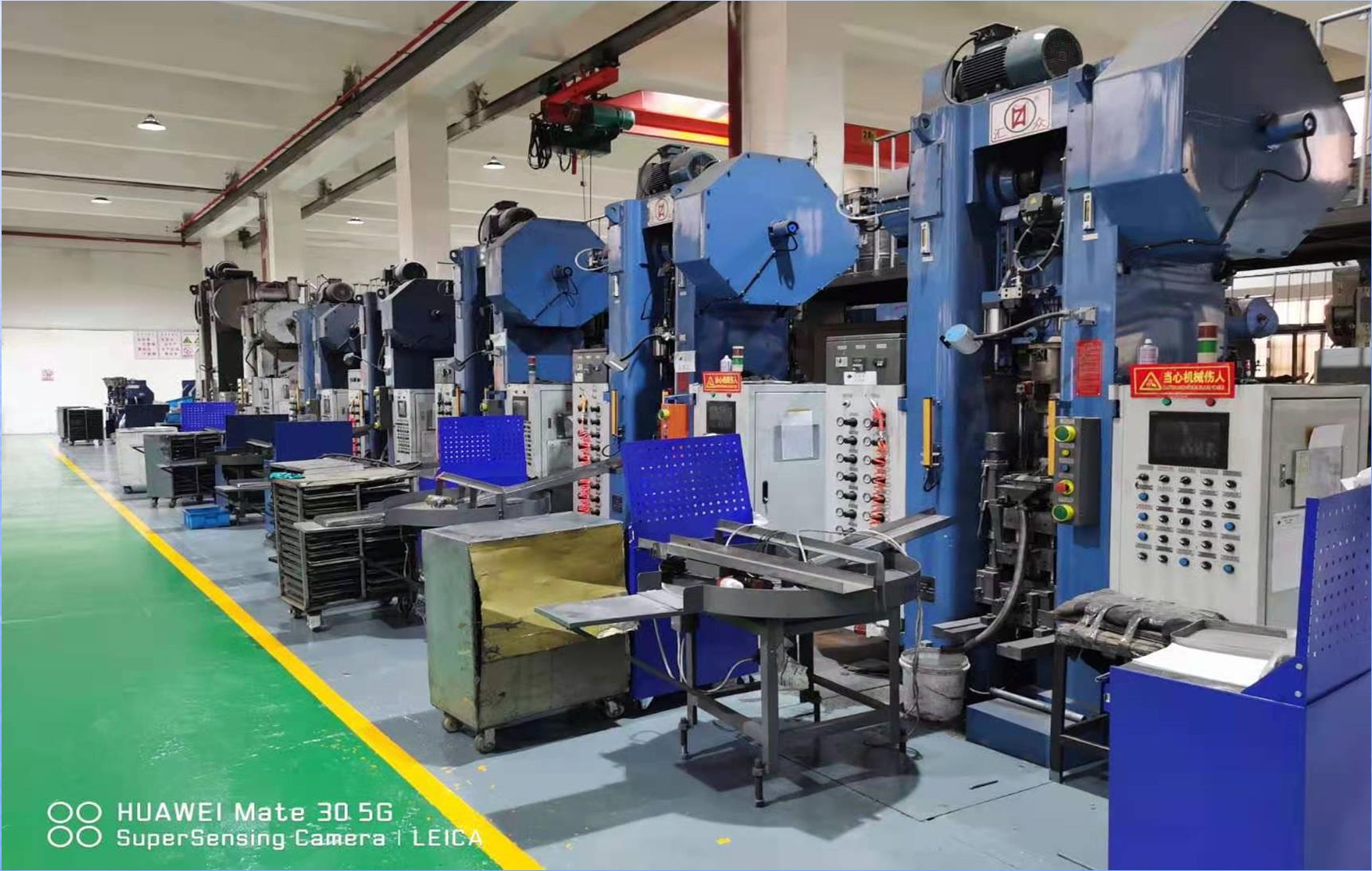
3. Compaction
Mixed powders are placed in dies and pressed under high pressure:
- Pressing Pressure: Typically 400-800 MPa (about 4-8 tons/cm2
- Press Types: Mechanical presses (fast) and hydraulic presses (high pressure)
- Green Density: Generally 75-85% of theoretical density
Pressing Methods:
- Single-action pressing: Simple and economical but uneven density distribution
- Double-action pressing: More uniform density distribution, mainstream method
- Isostatic pressing: Uses rubber molds for complex shapes
4. Sintering
Green compacts are heated in a protective atmosphere to bond powder particles:
- Sintering Temperature: Iron-based alloys typically 1120C, high-temperature sintering up to 1250-1300C
- Atmosphere: Hydrogen, nitrogen, or dissociated ammonia to prevent oxidation
- Hold Time: Usually 20-60 minutes depending on part size
- Shrinkage: Linear shrinkage of about 1-2% during sintering, compensated in die design
5. Secondary Operations
Depending on part requirements, the following may be needed:
Sizing
- Re-pressing sintered parts in precision dies
- Improves dimensional accuracy to IT6-7 grade
- Improves surface finish
Heat Treatment
- Quenching + tempering: Increases strength and hardness
- Carburizing: Increases surface hardness while maintaining core toughness
Surface Treatment
- Steam treatment: Forms dense oxide layer, improves airtightness and corrosion resistance
- Vacuum oil impregnation: For oil-impregnated bearings
- Electroplating: Zinc, nickel, chrome plating
- Dacromet: Environmentally friendly anti-corrosion coating
PM Applications
Powder metallurgy parts are widely used in:
- Automotive Industry: 60-70% of PM parts, including engine components, transmission parts, chassis parts
- Power Tools: Gears, bearings, structural parts
- Home Appliances: Washing machine gears, refrigerator compressor parts, air conditioner dampers
- Industrial Machinery: Hydraulic parts, transmission parts, sensor housings
- Medical Devices: Stainless steel surgical instruments, implants (MIM process)
PM vs Other Processes
| Characteristic | Powder Metallurgy | Casting | Forging | Machining |
|----------------|-------------------|---------|---------|-----------|
| Material Utilization | >95% | 70-80% | 80-90% | 50-60% |
| Dimensional Accuracy | High | Medium | Medium | Very High |
| Surface Roughness | Ra 1.6-3.2 | Ra 6.3-12.5 | Ra 3.2-6.3 | Ra 0.8-1.6 |
| Complex Shapes | Suitable | Suitable | Not Suitable | Not Suitable |
| Batch Cost | Low | Medium | Medium | High |
Conclusion
Powder metallurgy is a mature and advanced manufacturing technology, particularly suitable for high-volume production of precision, complex-shaped metal parts. As material technology and process equipment continue to advance, the application scope of powder metallurgy is constantly expanding.

Expert Review
Yao Qingpu
Powder Metallurgy Manufacturing Expert
Powder metallurgy manufacturing expert with 15+ years of experience in PM process development, gear applications, tolerance planning, quality control, and production troubleshooting.