
Cost Analysis
Powder Metallurgy vs CNC Machining: Cost, Tolerance, and Volume Guide
How to choose the right process based on annual volume, geometry, tolerances, and total part cost

Yao Qingpu
Powder Metallurgy Manufacturing Expert at SinterWorks Technology
Table of Contents
Quick Answer
CNC machining suits prototypes and low volumes because startup cost is lower and design changes are easier. Powder metallurgy usually becomes more cost-effective once demand moves into stable repeated volume, because material utilization is high, multiple features can be formed in one step, and unit cost drops after tooling is absorbed.
Key Takeaways
- CNC machining has lower startup costs but higher per-part costs that stay tied to machine time and material removal
- Powder metallurgy requires tooling investment but usually offers a lower unit cost once volume rises and geometry is PM-friendly
- PM material utilization often exceeds 95 percent, while CNC may scrap 40 to 60 percent of the starting stock as chips
- The economic break-even point often appears once demand reaches stable four-digit or low five-digit annual volume, but geometry and secondary operations matter
- Many programs use a hybrid route: PM for the base shape and secondary machining for critical precision features
Introduction
Powder metallurgy and CNC machining are both proven methods for making metal parts, but they solve different manufacturing problems.
CNC machining is flexible, accurate, and ideal when a program is still changing. Powder metallurgy is strongest when the design is stable, annual demand is high, and the part geometry allows near-net-shape production with very little waste.
For buyers, the wrong comparison is "Which process is better?" The right question is "Which process is better for this part, at this volume, with this tolerance target?"
How The Cost Structure Differs
Powder Metallurgy Cost Structure
Powder metallurgy has a higher front-end commitment, but lower unit cost once production stabilizes.
Main cost drivers:
- Tooling investment: precision dies and tooling are usually the largest one-time cost.
- Powder material cost: often efficient because material utilization can exceed 95%.
- Compacting and sintering cost: highly repeatable and efficient in volume production.
- Secondary operations: sizing, machining, heat treatment, steam treatment, or impregnation when required.
CNC Machining Cost Structure
CNC has lower startup cost, but unit cost stays relatively high because each part still consumes machine time.
Main cost drivers:
- Programming and setup time
- Raw stock material cost
- Material waste from cutting
- Cycle time per part
- Tool wear and operator oversight
This is why CNC feels inexpensive at prototype stage but often becomes expensive at scale.
PM vs CNC: Side-by-Side Comparison
| Factor | Powder Metallurgy | CNC Machining |
|---|---|---|
| Tooling cost | High upfront | Low to moderate |
| Unit cost at scale | Low | Higher |
| Material utilization | Often >95% | Often 50-70% |
| Best production volume | Medium to high volume | Prototype to low volume |
| Dimensional accuracy | Typically IT8-IT9, better after sizing | Typically IT6-IT7 or tighter |
| Surface finish | Good functional finish | Better cosmetic machined finish |
| Geometry efficiency | Excellent for repeatable net-shape parts | Excellent for flexible geometry changes |
| Design change flexibility | Lower after tooling release | High |
| Lead time for first sample | Longer due to tooling | Faster |
Material Efficiency and Expensive Alloys
Material economics are one of the clearest differences between the two routes.
For a finished 100 g steel part:
- PM may use about 102 to 105 g of powder, which keeps utilization above 95 percent.
- CNC machining may start from 200 g or more of stock, with the balance removed as chips.
That difference gets more important as material price rises. Stainless steel, copper alloys, and titanium programs often show a bigger PM advantage because wasted stock is expensive even before machining time is counted.
Where Powder Metallurgy Wins
Powder metallurgy is usually the better choice when:
- The part is ordered repeatedly over a long production life
- The shape is suitable for compaction and sintering
- Material waste matters
- The design includes features that would otherwise require multiple machining steps
- The buyer wants stable, repeatable cost across thousands of pieces
Good examples include:
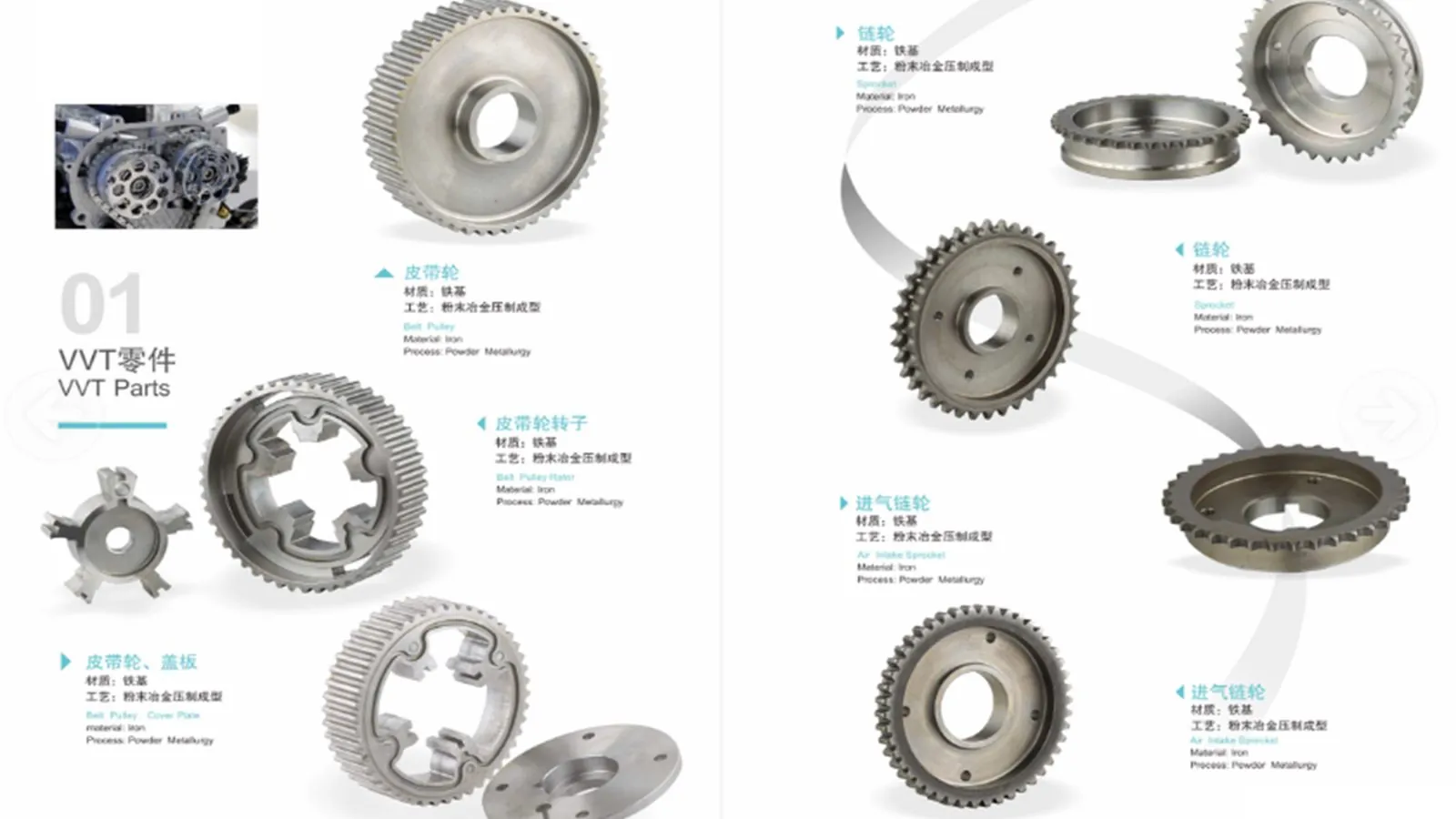
- Gears
- Sprockets
- Structural components
- Bearing-related parts
- Automotive transmission and engine parts
- Power tool gearbox parts
Where CNC Machining Wins
CNC machining is usually better when:
- The design is still changing
- The order volume is low
- The part requires very tight tolerances across multiple machined surfaces
- The material is not practical for powder metallurgy
- The geometry is not friendly to pressing direction or die release
Good examples include:
- Prototypes
- Fixtures and trial parts
- Very low annual volume custom parts
- Parts with deep side features or extensive undercuts
- Parts requiring extensive post-machining anyway
Tolerance and Surface Finish: What Buyers Should Expect
One reason buyers choose CNC is confidence in precision. That is valid, but the full picture is more nuanced.
Powder metallurgy can produce strong dimensional consistency for many production parts, especially where functional tolerances are realistic for the PM process. Standard PM parts often target about IT8 to IT9, and sizing can improve key dimensions further. If a part needs local precision on critical bores, faces, or threads, hybrid production is common: PM for the base shape, machining for key features.
CNC remains better when a part needs:
- tight concentricity across multiple machined surfaces
- cosmetic machined appearance
- very low roughness
- small-batch flexibility with high precision
So the choice is not always PM or CNC. In many programs, the best answer is PM plus limited secondary machining.
Example Cost Logic
Consider a repeat steel part that weighs around 80 g and has gear-like or structural geometry.
Illustrative Cost Comparison
| Cost Element | Powder Metallurgy | CNC Machining |
|---|---|---|
| Tooling amortization | $0.32 | $0.04 |
| Material | $0.65 | $1.40 |
| Processing | $1.20 | $4.50 |
| Heat treatment | $0.45 | $0.45 |
| Total per part | $2.62 | $6.39 |
This kind of comparison shows why CNC feels cheaper at the beginning, but PM often wins after tooling is spread across enough parts.
A Practical Break-Even Example
If a PM tool package costs $35,000 more than the machining route, and PM saves about $4.50 per part in combined material and processing cost, the break-even point is roughly:
$35,000 / $4.50 = 7,778 parts
That does not mean every program breaks even at exactly the same number. Real break-even depends on:
- annual demand
- machining cycle time
- scrap allowance
- raw material price
- how many features PM can form directly
- whether sizing, machining, or heat treatment is required after sintering
Still, for stable repeat parts, the economic crossover often appears once annual demand reaches solid four-digit volume.
Lead Time and Production Speed
CNC normally wins the race to first samples. Programming, fixturing, and early prototypes can often move in days or weeks, while PM needs tooling design and tool build before first articles are ready.
After tooling release, the balance changes:
- PM is built for repeated production and can scale efficiently with automated press-and-sinter flow.
- CNC remains flexible, but each part still consumes machine time and setup capacity.
That is why many teams prototype with machining, then shift a stable design into PM for production.
Questions Buyers Should Ask Before Choosing
Before deciding on PM or CNC, ask:
- Is the annual volume stable enough to justify tooling?
- Can the part be redesigned slightly to become PM-friendly?
- Which dimensions truly need machining-level accuracy?
- Is material utilization an important cost driver?
- Will the part stay in production for several years?
These questions usually reveal the right process much faster than comparing unit price alone.
A Practical Decision Guide
Choose powder metallurgy when:
- annual volume is medium to high, often above roughly 5,000 pieces
- the design is stable
- the material is PM-compatible
- geometry benefits from net-shape production
- total cost matters more than prototype flexibility
Choose CNC machining when:
- annual volume is low
- design changes are still likely
- the part needs very tight machined tolerances
- the geometry is not suitable for pressing
- speed to first sample matters most
Choose PM + secondary machining when:
- the main body can be formed economically by PM
- only a few surfaces or holes need tighter tolerances
- you want lower cost than full CNC without losing critical precision
Conclusion
Powder metallurgy is not a replacement for CNC in every case, and CNC is not automatically the premium option for every part.
For low-volume or evolving programs, CNC is often the better path. For stable, repeatable, higher-volume parts, powder metallurgy usually offers stronger economics, better material efficiency, and a more scalable production model.
If you are comparing PM and CNC for a real part, the best next step is to review the drawing, annual quantity, target tolerances, and material together. That is usually where the correct answer becomes obvious.
Need Help Comparing PM vs CNC for Your Part?
If you share your drawing, annual volume, material target, and critical tolerances, our engineering team can help you judge whether:
- CNC is the better prototype route
- PM can reduce total cost in production
- or a hybrid PM + machining route will give the best result
Contact SinterWorks for drawing review, process recommendation, or quote support.
Related Resources
Use these internal guides to keep exploring process planning, materials, quality control, and quoting steps for this topic.
What Is DFM in Powder Metallurgy? 8 Rules for Sintered Parts
Product engineers designing sintered metal parts: this guide covers the 8 PM DFM rules — pressing direction, wall thickness, draft angles, shrinkage planning, cross holes, and secondary operations — that prevent tooling problems before die release.
PM Material Selection Guide: Choosing the Best Material for Your Application
Different applications require different PM materials. This article details the performance characteristics, application scenarios, and selection recommendations for commonly used PM materials including iron-based, copper-based, and stainless steel.
What Is Powder Metallurgy? Process, Benefits, Materials, and Applications
Learn what powder metallurgy is, how the PM process works, what materials it uses, and why it is often chosen for high-volume precision metal parts with low material waste.
Powder Metallurgy Tooling Cost Guide: What Drives Cost and When It Pays Back
Understand what drives powder metallurgy tooling cost, from part geometry and cavities to tolerance demands and secondary operations, and learn when the investment pays back at production volume.
Frequently Asked Questions
At what volume does powder metallurgy become cheaper than CNC machining?
The break-even point varies by geometry, material, and tolerance target, but many repeat parts start to favor PM once demand climbs into the mid-thousands and stays stable long enough to absorb tooling cost across repeated runs.
Why does CNC machining usually create more material waste than PM?
CNC machining is a subtractive process that cuts material away from solid stock, while PM is a near-net-shape process that uses powder close to the final shape. That gives PM a major material-utilization advantage.
Is powder metallurgy suitable for prototypes?
PM can produce prototypes, but CNC machining is usually the better choice during design iteration because it avoids die tooling investment and supports design changes more easily.
Can PM and CNC machining be combined in one part program?
Yes. A common approach is to form the base geometry with PM and machine only the critical holes, faces, or threads that need tighter tolerance or finer surface finish.
Does CNC always have the lead-time advantage?
CNC is usually much faster for first samples because it avoids PM die tooling. After tooling is released, however, PM often scales more efficiently for repeat production because the press-and-sinter route can produce parts much faster than full machining.
Expert Review
Yao Qingpu
Powder Metallurgy Manufacturing Expert at SinterWorks Technology
Yao Qingpu works with global buyers on powder metallurgy design review, material selection, tolerance planning, cost-down opportunities, and production feasibility. His experience covers PM gears, automotive components, structural parts, and practical DFM support for long-run manufacturing programs.